
Bankruptcy Fraud: Warning Signs and Consequences
The Signs and Consequences of Bankruptcy Fraud
For millions of Americans weathering severe economic storms, filing for bankruptcy is a vital lifeline. It is a legally protected, constitutional tool engineered to grant honest but unfortunate debtors a genuine fresh start. When utilized properly, the bankruptcy code dissolves unmanageable financial burdens, halts aggressive creditor collection tactics, and lays the groundwork for a stable financial future.
However, because the system offers such a powerful benefit—the complete or partial erasure of debt—it is naturally a target for abuse.
In recent years, federal oversight bodies have significantly intensified their tracking, auditing, and enforcement protocols to combat bankruptcy fraud. When individuals or entities attempt to manipulate these legal protections for illicit gain, they undermine the integrity of the entire financial system.
Whether you are currently contemplating filing, navigating an active case, or working as a professional in the legal arena, understanding the warning signs, distinct variations, and severe consequences of bankruptcy fraud is absolutely vital. Maintaining strict transparency isn't just a best practice; it is the law.
What Exactly Constitutes Bankruptcy Fraud?
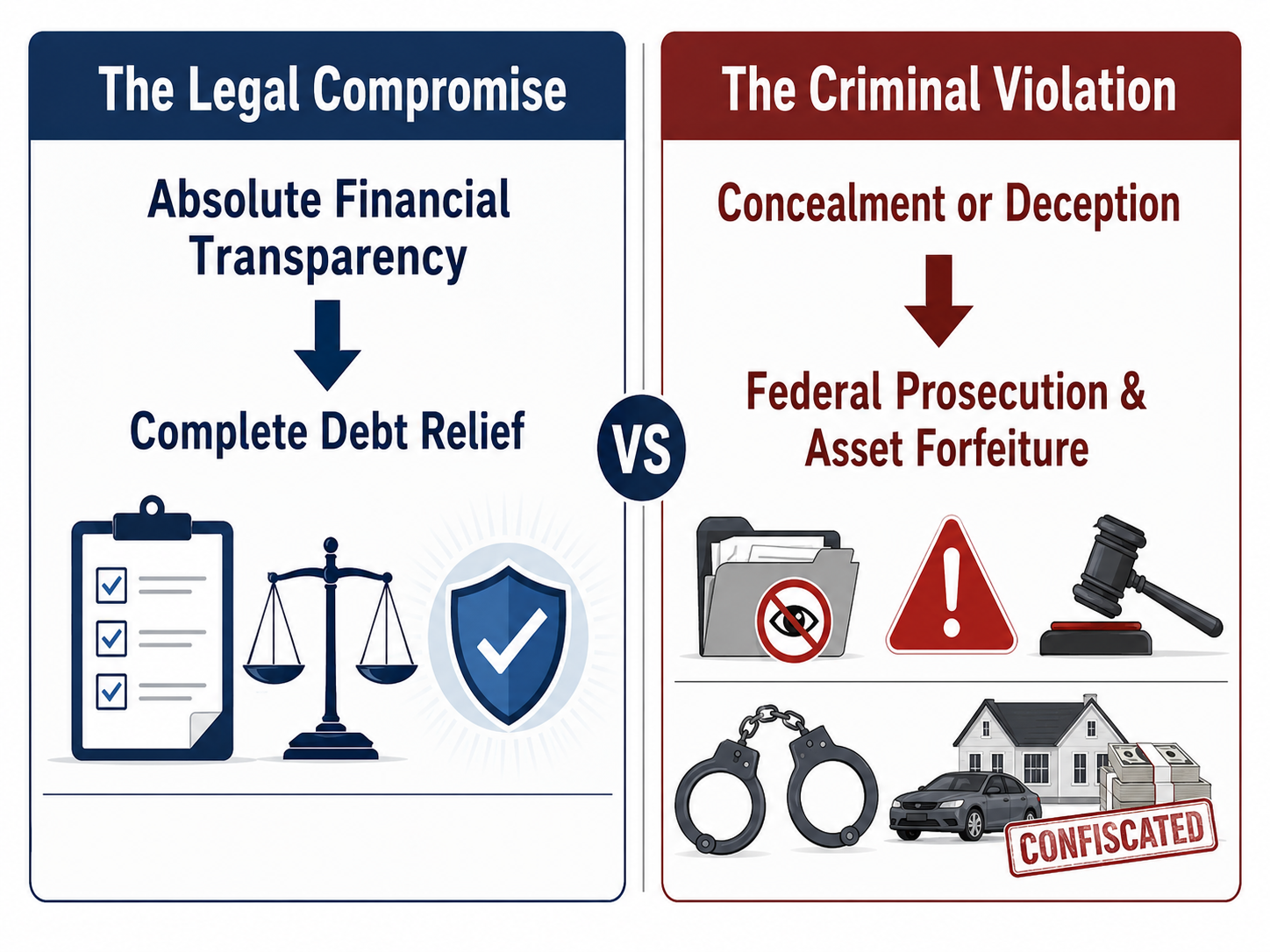
At its core, bankruptcy fraud is a white-collar federal crime that occurs when someone knowingly and intentionally misrepresents their financial reality to the court. The entire U.S. bankruptcy system is built on a fundamental compromise: you give the court an absolutely transparent, unvarnished look at your financial life, and in return, the court grants you legal relief from your creditors.
When a debtor breaks that compromise by lying, hiding assets, or intentionally omitting critical data, they commit a federal offense prosecuted under Title 18, Section 157 of the U.S. Code.
It is important to draw a clear line between an honest, accidental mistake and criminal fraud. The federal court system understands that bankruptcy paperwork is incredibly complex. Forgetting to list a decade-old bank account with a $12 balance or miscalculating a single month's utility expense is a common oversight. These errors can generally be corrected via simple amendments.
True fraud requires intent. It means the filer deliberately engaged in a scheme to deceive the bankruptcy trustee, the court, or their creditors to protect property or evade lawful obligations.
Common Types of Bankruptcy Fraud
The methods used to cheat the bankruptcy courts vary widely, ranging from crude omissions to highly sophisticated, multi-layered financial schemes. Federal investigators generally categorize these offenses into a few common types of bankruptcy fraud.
1. The Concealment of Assets
By far the most frequent violation of bankruptcy law involves hiding assets. In a Chapter 7 liquidation bankruptcy, non-exempt assets can be sold by a court-appointed trustee to repay your creditors. To avoid losing luxury items, cash, or real estate, some filers simply pretend these assets do not exist.
Asset concealment manifests in several distinct ways:
- The "Under-the-Table" Cash Transfer: Moving significant sums of money out of personal checking accounts and into a relative or friend’s account just weeks before filing.
- Cryptocurrency Hiding: Diverting liquid capital into unhosted crypto wallets, assuming digital assets are completely untraceable by federal authorities.
- Undervaluation of Property: Listing a rare art collection, luxury vehicle, or piece of real estate at a tiny fraction of its actual market value to exploit property exemptions.
- Omission of Side Income: Failing to report revenue streams from cash-based side hustles, freelance gigs, or independent consulting businesses.
2. Multiple or "Serial" Filings
Another prevalent abuse of the system involves exploiting the "automatic stay." The moment you file for bankruptcy, an automatic stay goes into effect, legally freezing all foreclosures, evictions, vehicle repossessions, and wage garnishments.
Fraudulent actors frequently weaponize this protection by executing serial filings—sometimes referred to as "shotgun filings." A scammer might file for bankruptcy in one state under their legal name to halt a foreclosure, let the case get dismissed for failing to submit paperwork, and then immediately file another petition in a neighboring state using a slightly altered name, an alternate address, or a fraudulent Social Security number. This keeps the automatic stay perpetually active, dragging out the collection process illegally for months or years.
3. The Threat of Petition Mills
Not all instances of bankruptcy fraud are initiated by the debtor. In many heartbreaking scenarios, the filer is actually the victim of a predatory scam known as a petition mill.
Petition mills typically operate under the guise of "foreclosure rescue" or "tenant advocacy" companies. They target vulnerable, low-income individuals who are facing immediate eviction or home foreclosure. The company charges the consumer an exorbitant monthly fee, promising to handle all negotiations with the landlord or bank.
Instead of negotiating, the petition mill secretly files a poorly constructed bankruptcy petition in the consumer’s name without their explicit consent or full understanding. While this temporarily halts the eviction, it ruins the victim's credit profile, saddles them with an unauthorized bankruptcy record, and frequently involves falsified financial schedules that expose the unsuspecting consumer to federal fraud investigations.
Early Warning Signs and Red Flags
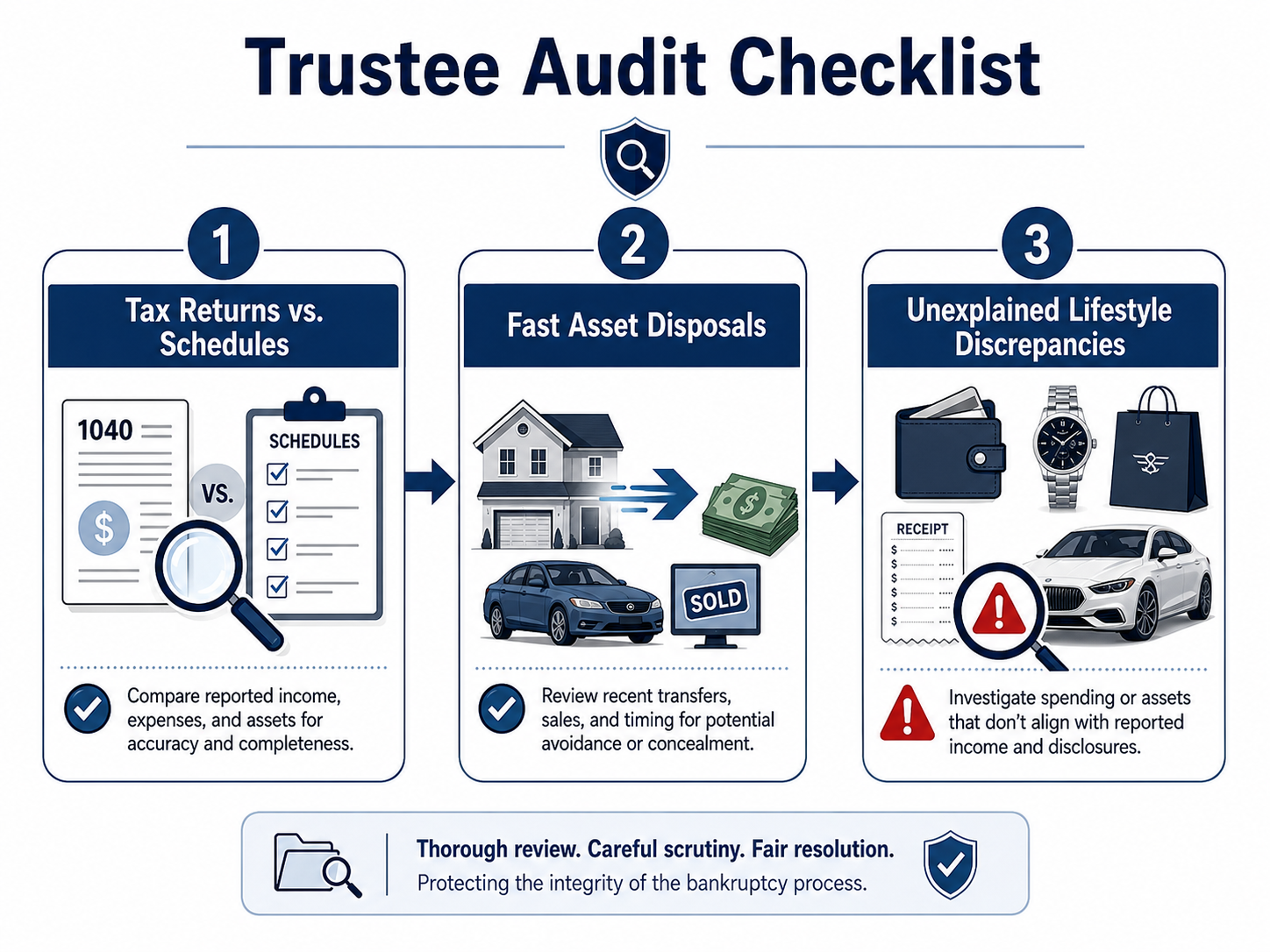
Federal bankruptcy trustees are seasoned financial investigators. They review thousands of cases a year and are trained to spot subtle anomalies that point to hidden assets or systemic dishonesty.
If you are an attorney reviewing a client's history, or an individual wanting to ensure your paperwork is beyond reproach, you must look out for these prominent warning signs:
Sudden Property Transfers
Deeding a home, transferring a vehicle title, or signing over a business share to a third party for "nominal consideration" (such as selling a $50,000 boat to a sibling for $1) within two years of filing is an immediate red flag. The bankruptcy code grants trustees "look-back" powers, allowing them to thoroughly audit all major transactions made prior to filing. If a transfer was completed with the clear intent to keep the property away from creditors, it is categorized as a fraudulent conveyance.
Drastic Discrepancies Between Tax Returns and Schedules
Your bankruptcy schedules require you to list your exact income and asset values under penalty of perjury. Trustees cross-examine these figures against your official IRS tax transcripts from previous years. If your tax returns from last year show a booming corporate consultancy pulling in mid-six figures, but your bankruptcy paperwork claims you are currently making zero income with absolutely no corporate assets left over, you can expect a comprehensive forensic audit.
Unexplained Decreases in Net Worth
If a debtor's financial history shows they held substantial corporate stock, valuable real estate portfolios, or robust savings balances six months ago, but those balances have suddenly vanished without a corresponding paper trail showing legitimate expenditures or market losses, it signals asset dumping or hidden offshore routing.
The Severe Consequences of Bankruptcy Fraud

The federal government takes the protection of the bankruptcy courts incredibly seriously. When a filer is caught intentionally deceiving the system, the backlash is swift, multi-faceted, and potentially life-altering. The consequences of bankruptcy fraud span criminal penalties, civil judgments, and permanent reputational destruction.
1. Federal Criminal Penalties
Because bankruptcy is a matter of federal law, violations are handled by federal prosecutors in United States District Courts, often following investigations spearheaded by the FBI or the Internal Revenue Service (IRS). A criminal conviction for bankruptcy fraud carries maximum penalties that include:
- Up to five years in federal prison per individual count of fraud.
- Criminal fines reaching as high as $250,000 per offense.
- Lengthy periods of court-supervised probation post-release.
- A permanent, non-expungable federal felony record.
2. Devastating Civil and Financial Ruin
Even if a case does not meet the high threshold required for criminal prosecution by the Department of Justice, the civil court penalties can still completely devastate a debtor's financial landscape.
The Ultimate Penalty: Total Denial of Discharge. If a bankruptcy judge determines that you attempted to hide assets or lie on your schedules, the court can completely deny your bankruptcy discharge. This means you lose all the assets you tried to hide, but you still legally owe 100% of the debt you were trying to eliminate. Your creditors are instantly unleashed to resume lawsuits, wage garnishments, and bank levies indefinitely. Furthermore, you are permanently barred from ever discharging those specific debts in any future bankruptcy filing.
| Consequence Category | Specific Legal & Financial Actions | Long-Term Impact |
|---|---|---|
| Criminal Penalties | Federal prison sentences up to 5 years, fines up to $250,000. | Permanent felony record, loss of civil rights, confinement. |
| Civil Penalties | Absolute denial of debt discharge under 11 U.S.C. § 727. | You remain fully responsible for all debts; creditors resume collection. |
| Asset Forfeiture | Trustee seizes and sells all hidden or transferred property. | Loss of the home, vehicles, or cash you tried to illegally protect. |
| Professional Fallouts | Stripping of state professional licenses (Law, Medical, CPA). | Permanent loss of career path and long-term earning potential. |
3. Personal and Professional Reputational Collapse
A public record of federal fraud is professional poison. If you hold a specialized professional license—such as a real estate license, a medical license, a CPA certification, or a license to practice law—a fraud conviction will almost certainly trigger immediate revocation proceedings by your state board. Employers are universally hesitant to hire anyone with a documented history of financial deception, severely capping your future earning potential and career mobility.
How to Protect Yourself and Maintain Absolute Compliance
The easiest way to steer clear of allegations of bankruptcy fraud is remarkably simple: embrace total, uncompromising honesty. The bankruptcy system is fundamentally designed to help people who are transparent about their financial struggles.
To ensure your filing remains safe, legal, and compliant, implement the following guardrails:
- Gather Impeccable Documentation: Before filling out a single page of your bankruptcy petition, collect a minimum of six months of pay stubs, two years of tax returns, bank statements for every account bearing your name, vehicle titles, and real estate appraisals. Let the documentation drive the data.
- Disclose Every Single Asset: When in doubt, list it. It does not matter if you think an asset has no monetary value, or if you believe a piece of property belongs entirely to your business entity rather than you personally. Let your legal counsel determine how to protect it using lawful bankruptcy exemptions.
- Avoid "Gurus" and Unlicensed Preparers: If a debt relief service or document preparer advises you to omit an account, transfer a car title to a relative before filing, or use an alternate Social Security number to "test the system," walk away immediately. You are dealing with a criminal operation that will leave you holding the legal blame.
Secure Expert Legal Counsel for a Safe Fresh Start
Navigating the nuances of federal bankruptcy law is a high-stakes endeavor. Trying to handle the process yourself, or relying on unverified advice from internet forums, is a recipe for catastrophic legal exposure. Working with an experienced, ethical bankruptcy attorney is your single greatest shield against unintended errors and potential fraud accusations.
A qualified attorney will systematically audit your financial history, cross-reference your assets against applicable state or federal exemptions, and ensure every single document submitted to the court is entirely accurate and legally compliant.
Don't risk your financial recovery, your assets, or your personal freedom by guessing your way through complex court filings. If you are ready to explore your options for real, lawful debt relief, reach out to our office today to schedule a confidential, comprehensive consultation. Let our dedicated team guide you safely toward the genuine financial reset you deserve.
Bankruptcy Fraud FAQ's
Are there any technological measures or tools to detect bankruptcy fraud?
Yes. Bankruptcy trustees, federal investigators, and financial institutions may use a range of technological tools to identify inconsistencies in a bankruptcy filing. These can include database cross-checks, tax transcript reviews, bank record analysis, asset searches, property record checks, and digital transaction tracking. In more complex cases, investigators may also review cryptocurrency activity, business records, and electronic payment histories. While technology can help flag suspicious activity, the most important protection for filers is still complete honesty and accurate documentation.
Can bankruptcy fraud affect innocent bystanders, like employees of a company?
Yes. Bankruptcy fraud can affect people who had no role in the misconduct, especially in business bankruptcy cases. Employees may face delayed wages, job loss, reduced benefits, or uncertainty if a company’s assets or financial records were manipulated. Creditors, vendors, investors, and business partners can also be harmed when fraud interferes with the fair distribution of assets. In some cases, innocent employees or associates may be asked to provide records or testimony as part of an investigation, even if they are not accused of wrongdoing.
If I mistakenly provide inaccurate information during my bankruptcy filing, can I be charged with fraud?
A simple mistake is not the same as bankruptcy fraud. Fraud generally requires intent, meaning the person knowingly and deliberately provided false information, hid assets, or misled the court. Bankruptcy paperwork can be complicated, and honest errors sometimes happen. If you discover a mistake, it is important to correct it as soon as possible through the proper legal process. Working with an experienced bankruptcy attorney can help ensure your filing is accurate, complete, and compliant from the start.









Share On: