
How Bankruptcy Affects Tenants and Landlords
How Bankruptcy Affects Tenants and Landlords: An Oregon Legal Guide
Financial hardship can strike unexpectedly, creating a ripple effect that touches every corner of daily life. For individuals and business owners renting real estate, severe financial strain quickly translates into anxiety over losing a home or commercial storefront. At the same time, property owners rely on consistent rent payments to meet their own financial obligations, including mortgages, property taxes, maintenance costs, and building operations. When a tenant files for bankruptcy, the legal dynamic between the property owner and the occupant shifts immediately.
Understanding how Bankruptcy and Renters intersect requires navigating two distinct bodies of law: federal bankruptcy statutes and state property codes, such as Oregon landlord-tenant law. This legal interplay dictates whether a tenant can remain in their home, how back rent is handled, and what actions a property owner can legally pursue. Whether you are a tenant striving to protect your living situation or a landlord seeking to manage unpaid rent, knowing how bankruptcy and eviction rules function is vital for safeguarding your legal rights.
The Intersection of Federal Bankruptcy Law and Rental Contracts

Federal bankruptcy laws exist to provide overburdened debtors with a fresh financial start while establishing an orderly framework for creditors to recover outstanding balances. The moment a tenant files a bankruptcy petition with the United States Bankruptcy Court, their residential or commercial lease becomes part of the legal entity known as the "bankruptcy estate."
The federal court assumes temporary jurisdiction over the debtor's contracts, assets, and liabilities. State law continues to govern the basic rights and duties of property possession, but federal bankruptcy law overrides state-level eviction enforcement to ensure all creditors are treated fairly according to statutory priorities.
Pre-Petition vs. Post-Petition Rental Debt
A fundamental distinction in bankruptcy law lies between pre-petition debt and post-petition obligations.
- Pre-Petition Debt: Refers to any unpaid rent or fees accrued before the exact minute the bankruptcy petition is filed. Pre-petition rent is treated as unsecured debt within the bankruptcy proceeding.
- Post-Petition Debt: Refers to rent and utility obligations that accrue after the bankruptcy filing date. Tenants remain strictly responsible for paying post-petition rent if they wish to remain on the property.
Chapter 7 vs. Chapter 13 Bankruptcy for Residential Renters
Residential tenants facing financial hardship generally file under one of two primary chapters of the Bankruptcy Code: Chapter 7 or Chapter 13. Each option handles unexpired leases and past-due rent in fundamentally different ways.
| Feature / Consideration | Chapter 7 Bankruptcy | Chapter 13 Bankruptcy |
|---|---|---|
| Core Objective | Full liquidation of non-exempt assets to discharge unsecured debts. | Structured 3-to-5-year repayment plan to catch up on debts. |
| Handling of Back Rent | Discharges personal liability for pre-petition past-due rent. | Cures pre-petition rent arrears gradually through monthly plan payments. |
| Impact on Housing | Delays eviction temporarily; tenant must pay ongoing rent to stay. | Allows tenant to cure arrears and retain housing long-term. |
| Lease Option | Trustee typically rejects lease unless value exists for creditors. | Tenant assumes lease, cures back rent, and maintains ongoing terms. |
| Best Suited For | Renters needing fast debt relief who are current on rent or prepared to move. | Renters behind on rent who have reliable income to pay back arrears. |
Chapter 7 Bankruptcy: Liquidation and Renters
Chapter 7 bankruptcy is designed to eliminate unsecured debts, including credit card balances, medical bills, personal loans, and past-due rent. For residential tenants, a Chapter 7 filing provides immediate relief from money judgments and collection calls associated with back rent.
However, Chapter 7 does not grant a tenant the right to live rent-free. While it wipes out the personal legal obligation to pay pre-petition rent, it does not erase the landlord's underlying property rights. If a tenant is behind on rent and files Chapter 7, the landlord cannot collect the back rent directly, but they can still seek court permission to recover possession of the real estate if post-petition rent goes unpaid or if the tenant cannot cure the default.
Chapter 13 Bankruptcy: Reorganization and Catching Up on Rent
Chapter 13 bankruptcy offers a powerful mechanism for tenants who have fallen behind on rent due to temporary job loss, illness, or emergency expenses but now possess stable income.
Under Chapter 13, a tenant can propose a repayment plan lasting between three and five years. The debtor can include past-due rent (pre-petition arrears) in the plan, paying off the debt in manageable monthly installments. As long as the tenant makes all required plan payments to the Chapter 13 trustee and continues paying current post-petition monthly rent directly to the landlord, the landlord cannot evict the tenant for the past default. This makes Chapter 13 an effective tool for keeping families housed while regaining financial health.
Commercial Leases and Small Business Bankruptcy Filings
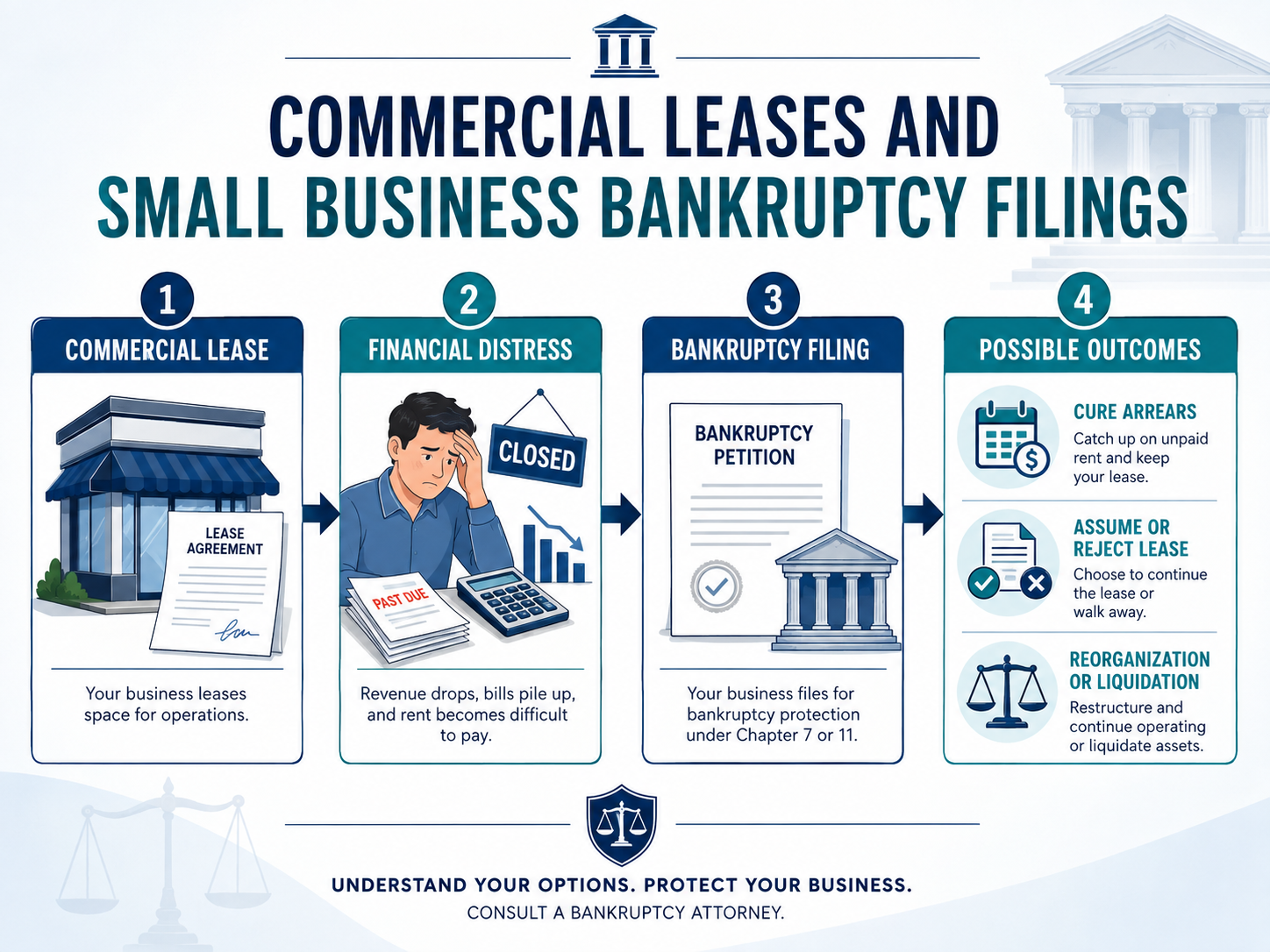
Financial distress affects commercial tenants just as heavily as residential occupants. Small businesses struggling with declining revenue often find commercial lease obligations unsustainable. When a small business files for bankruptcy, Section 365 of the Bankruptcy Code governs how the commercial lease is handled.
Chapter 7 Liquidation for Commercial Tenants
When a small business operating as a corporation, LLC, or sole proprietorship files under Chapter 7, the entity generally ceases operations. A court-appointed bankruptcy trustee takes control of the business assets, including lease agreements.
In almost all commercial Chapter 7 cases, the trustee rejects the commercial lease because continuing to pay rent does not benefit general unsecured creditors. Once the lease is formally rejected, the commercial landlord gains immediate possession of the property and can file an unsecured proof of claim with the bankruptcy court for back rent and lease termination damages.
Chapter 13 and Chapter 11 Reorganization for Businesses
Sole proprietors can utilize Chapter 13, while corporations and partnerships typically utilize Chapter 11 to reorganize. Under these chapters, small business owners have three choices regarding their commercial lease:
- Assume the Lease: The business elects to keep the lease active. To assume the lease, the debtor must cure all monetary defaults (or provide adequate assurance that the default will be cured quickly) and demonstrate the ability to perform future lease obligations.
- Reject the Lease: The business terminates the lease agreement. The landlord gets the keys back, and any damages arising from the broken contract are treated as pre-petition unsecured claims.
- Assign the Lease: The business transfers the lease agreement to a third party, subject to court approval and adequate assurance of future performance by the new tenant.
Commercial leases have strict statutory timelines. Under 11 U.S.C. § 365(d)(4), a debtor must assume or reject an unexpired lease of nonresidential real property within 120 days of filing the bankruptcy petition, though a court may grant a limited extension for cause.
The Automatic Stay and Its Impact on Evictions
The cornerstone of any bankruptcy petition is the automatic stay, authorized under Section 362 of the Bankruptcy Code. The instant a bankruptcy petition is filed, an automatic injunction goes into effect.
The automatic stay pauses all collection efforts, lawsuits, foreclosures,
wage garnishments, and pending eviction proceedings. For landlords, learning that a tenant has filed for bankruptcy means all legal actions regarding
bankruptcy and eviction must stop instantly. Continuing an eviction without court clearance can lead to severe penalties.

Critical Exceptions to the Automatic Stay in Eviction Cases
While the automatic stay is broad, federal bankruptcy law provides specific exceptions to prevent tenants from using bankruptcy solely to delay lawful evictions:
- Pre-Petition Judgments of Possession: Under 11 U.S.C. § 362(b)(22), if a landlord obtained a formal court judgment of possession before the tenant filed the bankruptcy petition, the automatic stay may not prevent the enforcement of that judgment. To stay the eviction, the tenant must meet strict requirements: certify on the bankruptcy petition that state law allows them to cure the monetary default after judgment, and deposit the next 30 days of rent with the bankruptcy clerk.
- Endangerment or Illegal Substance Use: Under 11 U.S.C. § 362(b)(23), if the eviction is based on residential endangerment or the illegal use of controlled substances on the leased premises, a landlord can file a certification with the bankruptcy court to proceed with state eviction enforcement without waiting for formal relief from the stay.
Motion for Relief from the Automatic Stay
If a tenant stops paying rent that comes due after the bankruptcy filing (post-petition rent), or if the automatic stay applies to a pre-petition eviction case without valid legal grounds, the landlord can file a Motion for Relief from the Automatic Stay.
The bankruptcy court will schedule a hearing. If the judge finds that the tenant is not paying post-petition rent or cannot adequately protect the landlord's financial interest in the property, the court will lift the stay. Once the stay is lifted, the landlord is legally clear to resume eviction proceedings in state court.
Tenant Rights and Obligations Under Oregon Landlord Tenant Law
Navigating
Tenant Rights in Bankruptcy requires looking closely at how federal rules mesh with state property statutes. In Oregon, residential tenancies are governed by the Oregon Residential Landlord and Tenant Act (ORS Chapter 90).
Protection Against Unlawful Self-Help Evictions
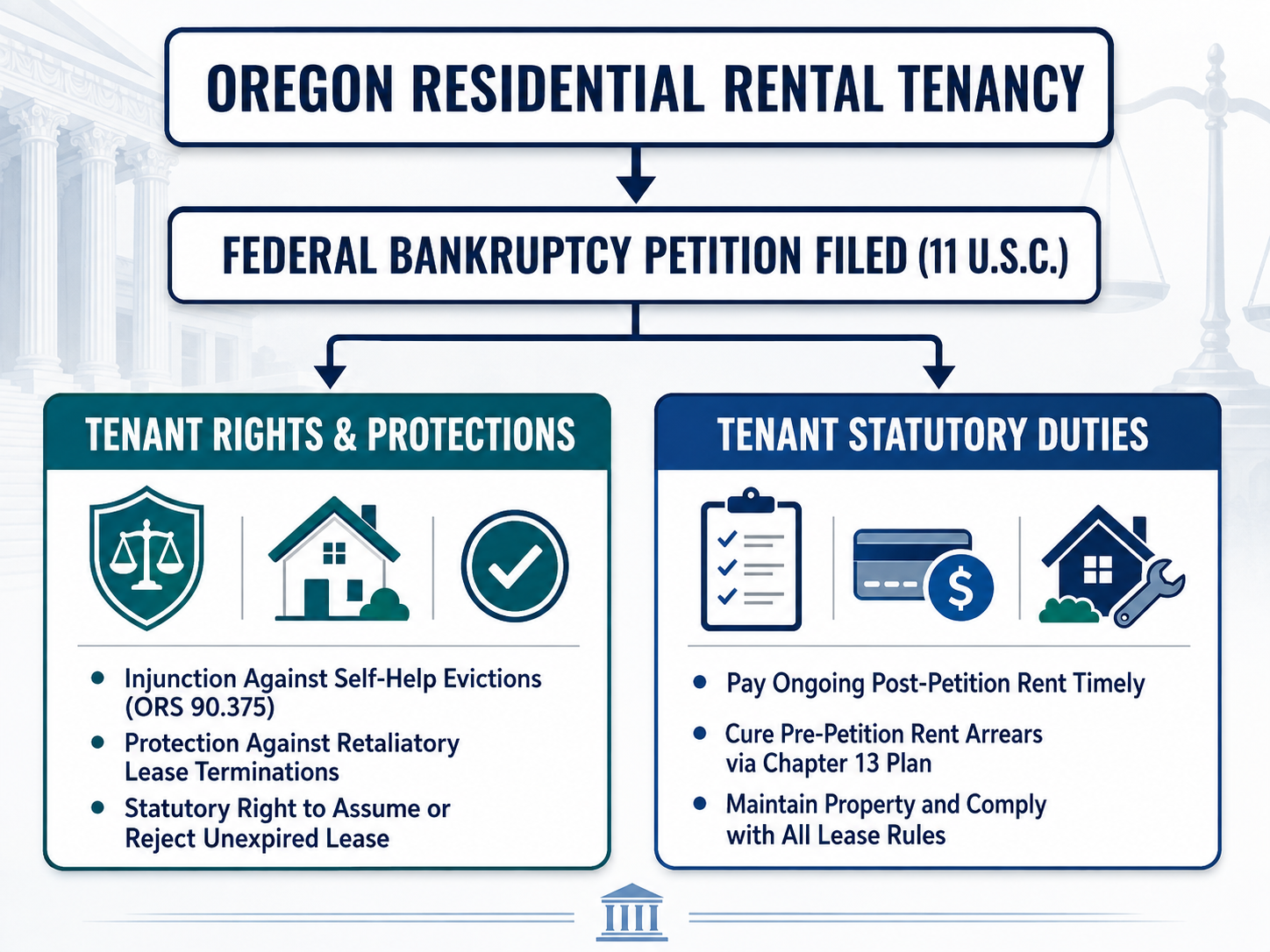
Filing for bankruptcy does not strip renters of state law protections; in fact, it enhances them. Under Oregon landlord-tenant law, landlords are strictly forbidden from engaging in self-help evictions. Even if a tenant owes several months of rent and has filed for bankruptcy, a landlord cannot:
- Change the locks or restrict access to the rental unit.
- Shut off essential services, including water, gas, electricity, or heat.
- Remove doors, windows, or the tenant's personal property from the unit.
Under ORS 90.375, an unlawful self-help eviction entitles the tenant to recover possession or terminate the rental agreement, while recovering an amount equal to two months' periodic rent or twice the actual damages sustained, whichever is greater.
Essential Obligations for Tenants in Bankruptcy
While federal and state laws provide significant shelter, tenants retain clear ongoing duties:
- Pay Post-Petition Rent: Tenants must pay ongoing monthly rent on time starting from the day the bankruptcy petition is filed.
- Comply with Lease Terms: Bankruptcy shields debtors from unpaid pre-petition money, not from lease violations involving property damage, unauthorized occupants, or illegal activity.
- Cure Arrears in Chapter 13: Renters using Chapter 13 must strictly fulfill their trustee plan payments alongside ongoing monthly rent.
Landlord Rights, Limitations, and Best Practices
Landlords faced with a tenant bankruptcy filing must manage the situation carefully to protect their rental income while staying in compliance with federal court mandates.
Core Landlord Rights
- Right to Post-Petition Payment: Landlords are entitled to receive full, timely rent payments for every month the tenant occupies the unit after filing for bankruptcy.
- Right to File a Proof of Claim: For unpaid pre-petition rent, landlords can file a Proof of Claim with the bankruptcy court to ensure they receive their pro-rata share of any disbursements made from the bankruptcy estate.
- Right to Seek Relief from the Stay: Landlords can ask the bankruptcy court for permission to evict if post-petition rent goes unpaid or if the tenant breaches non-monetary lease terms.
Recommended Steps for Oregon Landlords
- Halt Direct Collection Efforts: Instantly cease issuing payment demands, late fee notices, or eviction threats for pre-petition balances to prevent automatic stay violations.
- Obtain Official Documentation: Request the formal bankruptcy case number, filing date, and court district. Confirm the filing using the federal court PACER (Public Access to Court Electronic Records) system.
- Separate Accounting Ledgers: Maintain two distinct financial ledgers: one for pre-petition debt accrued prior to filing, and one for post-petition rent accruing after filing.
- Monitor Post-Petition Compliance: Document all post-petition payments meticulously. If the tenant defaults on rent due after the filing date, issue appropriate state statutory notices in consultation with legal counsel.
- Act Promptly in Bankruptcy Court: Work with a qualified attorney to file a Motion for Relief from Stay if post-petition non-payment occurs, rather than waiting for the bankruptcy case to resolve itself naturally.
Intersecting Federal Bankruptcy with Oregon FED Evictions
In Oregon, formal eviction lawsuits are known as Forcible Entry and Detainer (FED) actions, prosecuted under ORS Chapter 105 in county circuit courts. The specific timing of a tenant's bankruptcy filing dramatically affects how an FED case unfolds.
Filing Before an FED Action Commences
If a tenant files for bankruptcy before the landlord files an FED summons and complaint in an Oregon court, the landlord cannot start the eviction process without first securing an order from the bankruptcy court granting relief from the stay.
Filing During an Active FED Lawsuit
If a bankruptcy petition is filed while an FED action is pending in an Oregon court (such as Multnomah, Washington, or Clackamas County Circuit Court), the state judge must suspend all proceedings immediately upon receiving formal notice of the bankruptcy filing. The case remains frozen until the bankruptcy court lifts the stay or closes the bankruptcy case.
Filing After a Writ of Execution Is Issued
If the Oregon circuit court has already entered a final judgment of possession and the sheriff has posted a Notice of Restitution, the tenant's ability to halt the physical eviction via bankruptcy is narrowly restricted under federal law. Unless the tenant meets the strict 30-day rent deposit and certification requirements set forth in 11 U.S.C. § 362(b)(22), the sheriff can move forward with executing the writ.
Practical Steps for Managing Rental Bankruptcies
Checklist for Tenants
- Consult a Bankruptcy Attorney Early: Reach out to legal counsel before a landlord obtains a state court judgment of possession, as timing dictates available remedies.
- Gather Comprehensive Documentation: Provide your lawyer with your current lease agreement, rent ledgers, payment receipts, and any notices received from your landlord.
- Budget for Post-Petition Housing Costs: Ensure you have the financial means to pay your ongoing monthly rent starting from the date of filing.
- Maintain Open Communication: Keep your attorney informed of any communication received from your landlord or property manager.
Checklist for Landlords
- Seek Legal Advice Immediately: Contact a legal professional experienced in both oregon landlord tenant law and federal bankruptcy practice as soon as you receive notice of a tenant's filing.
- Avoid Self-Help Measures: Do not change locks, terminate utilities, or attempt direct collection of pre-petition rent.
- File a Proof of Claim: Ensure your claim for pre-petition back rent is properly registered with the bankruptcy court before the statutory bar date.
- Enforce Post-Petition Obligations: If the tenant fails to pay rent that comes due after the filing date, work with your attorney to move for relief from the stay promptly.
The legal intersection of federal bankruptcy, rental agreements, and state property law involves precise deadlines, complex filing procedures, and significant legal protections for both property owners and occupants. Whether you are a tenant aiming to stop an eviction and stabilize your living situation or a landlord seeking to safeguard your property rights, working with an experienced Oregon bankruptcy attorney ensures your interests are fully protected throughout the legal process. Contact a knowledgeable bankruptcy attorney today to evaluate your options and navigate your case with clarity and confidence.
Landlord and Tenant Bankruptcy FAQ's
Can a landlord refuse to rent to someone who has a bankruptcy on their record?
Generally, yes. A private landlord may consider an applicant’s credit history and tenant-screening information when deciding whether to approve a rental application, and a prior bankruptcy can appear in that information. Federal bankruptcy anti-discrimination protections do not broadly prohibit private landlords from considering bankruptcy when screening tenants. In Oregon, landlords may use written screening criteria that include credit reports, credit references, income, and other financial information. However, landlords must still comply with fair housing laws and other applicable state or local protections. If a landlord denies an application or imposes less favorable terms because of information in a consumer or tenant-screening report, federal law generally requires an adverse action notice explaining the applicant’s rights.
Can a landlord increase rent to cover potential losses if they know a tenant is considering bankruptcy?
A landlord does not receive a special right to raise a tenant’s rent simply because the tenant is considering bankruptcy. Any rent increase must comply with the existing rental agreement and applicable Oregon rent-increase laws. For most Oregon residential tenancies, rent generally cannot be increased during the first year, increases after the first year require at least 90 days’ written notice, and rent generally cannot be increased more than once during a 12-month period or above the applicable statutory limit unless an exemption applies. A landlord therefore cannot simply impose an immediate “bankruptcy surcharge” or additional rent outside the terms of the lease and applicable law.
Are landlords notified when a tenant files for bankruptcy?
Often, yes. If a tenant owes the landlord back rent or another pre-bankruptcy debt, the landlord will typically be listed as a creditor and receive notice of the bankruptcy case. Tenants are also required to disclose unexpired residential leases on Schedule G of their bankruptcy paperwork. Depending on how the landlord is listed in the case and the circumstances of the lease, the landlord may receive a formal bankruptcy notice from the court or Bankruptcy Noticing Center. A tenant or the tenant’s attorney may also notify the landlord directly, particularly when an eviction or other collection action needs to stop quickly.










Share On: