
Can Bankruptcy Clear Tax Debt? What Oregonians Should Know
What Oregonians Should Know About Bankruptcy & Tax Debt
Owing the IRS or the Oregon Department of Revenue can feel like a financial trap. Tax agencies can garnish paychecks, levy bank accounts and file liens without suing you first, and penalties and interest keep pushing the balance higher. So a question we hear often in our Eugene office is simple: does bankruptcy clear tax debt?
In many cases, yes. Bankruptcy can wipe out older federal and Oregon income taxes that pass a set of timing requirements known as the 3-2-240 rule. Some tax debts survive no matter how old they are, but filing still stops most collection right away and can turn the balance into a manageable plan.
Which Tax Debts Can Bankruptcy Clear?
Does bankruptcy clear taxes of every kind? No. Income taxes are the main tax debt that can be discharged, and each tax year is judged on its own:
| Type of tax debt | Can bankruptcy clear it? | What to know |
|---|---|---|
| Older federal or Oregon income tax | Often | The tax year must pass all of the timing rules below. |
| Recent income tax | No | A priority debt that must be paid in full, though Chapter 13 spreads it over three to five years. |
| Tax penalties | Often | A penalty can be discharged if the tax behind it can be, or if the event that caused it is more than three years old. |
| Payroll taxes withheld from employees, and the trust fund recovery penalty | No | They survive no matter how old they are. |
| Employer's share of payroll taxes | Sometimes | Can be discharged once the return was due more than three years before you file. |
| Tax on a fraudulent return or from willful evasion | No | Age does not matter. |
| Tax for a year with no return filed | No | A substitute return the IRS prepares for you does not count as your return. |
| Property taxes | Rarely | Recent property taxes are priority debts, and the lien on the property stays either way. |
Interest generally follows the tax, so discharged tax usually takes its interest with it.
The 3-2-240 Rule for Discharging Income Tax
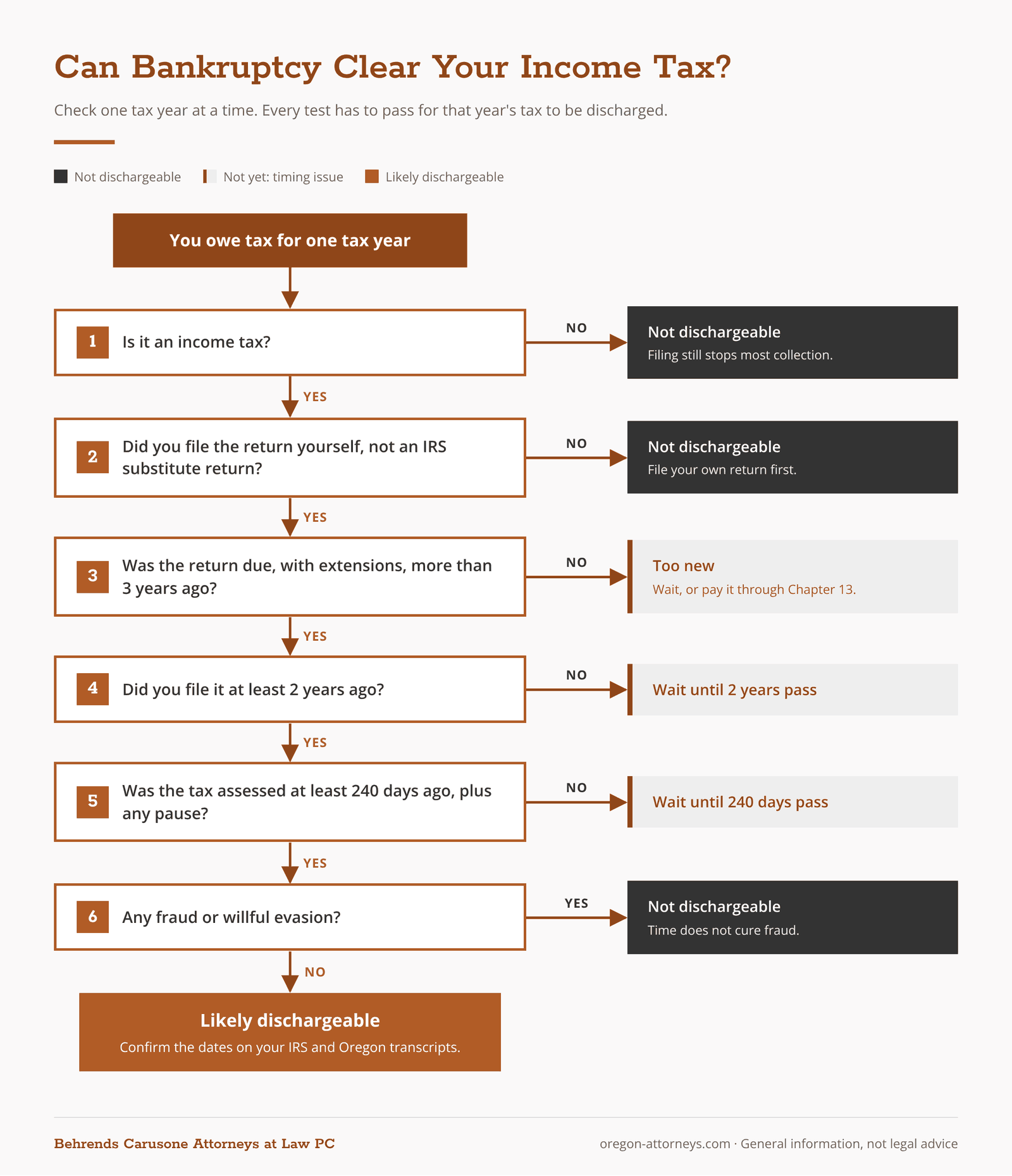
For an income tax year to be discharged, it has to pass four tests found in 11 U.S.C. § 523 and § 507(a)(8) of the Bankruptcy Code. The first three are about time:
| Rule | What it requires | Common mistake |
|---|---|---|
| 3-year rule | The return was last due, including extensions, more than three years before you file bankruptcy. | Forgetting extensions, which push the date later. |
| 2-year rule | You filed a valid return for that year at least two years before you file bankruptcy. | Counting an IRS substitute return, or a return filed after the IRS already assessed the tax. |
| 240-day rule | The tax was assessed at least 240 days before you file bankruptcy. | Missing a later assessment from an audit or amended return. The added tax gets its own 240 days. |
| No fraud or evasion | You did not file a fraudulent return or willfully try to evade the tax. | Assuming that time cures fraud. It does not. |
Fail any single test and that year's tax survives the bankruptcy.
Events That Pause the Clock
Some events legally pause (or "toll") the clocks and push your eligibility date later:
- Offer in compromise: a pending offer pauses the 240-day period, plus 30 days.
- Prior bankruptcy: an earlier case pauses the three-year and 240-day periods while it was open, plus 90 days.
- Collection Due Process hearing: a hearing request and appeal pause those same periods while the IRS was barred from collecting, plus 90 days.
Because these pauses are easy to miss, we pull your IRS and Oregon account transcripts before choosing a filing date.
Late-Filed Returns and Oregon's Federal Courts
Federal appeals courts disagree on late-filed returns. The First, Fifth and Tenth Circuits treat a return filed even one day late as no return at all. Oregon is in the Ninth Circuit, which is more flexible: a late return can count if it was an honest and reasonable attempt to comply, and the two-year clock starts when you filed it. But in In re Smith (2016), the Ninth Circuit held that a return filed after the IRS had already assessed the tax did not count. If you have unfiled years, file them before the IRS files for you.
A Timing Example for Back Taxes
Exact dates decide whether you can file bankruptcy on back taxes and have them discharged. Here is how the three-year rule plays out for recent years. Oregon's filing deadlines match the federal ones, though a disaster-area postponement can move them.
| Tax year | Return due (extended due date) | Three-year rule met if you file after |
|---|---|---|
| 2021 | April 18, 2022 (October 17, 2022) | April 18, 2025 (October 17, 2025) |
| 2022 | April 18, 2023 (October 16, 2023) | April 18, 2026 (October 16, 2026) |
| 2023 | April 15, 2024 (October 15, 2024) | April 15, 2027 (October 15, 2027) |
Say you filed your 2022 return on time and the IRS assessed the tax in spring 2023. By late 2026, that year passes all three timing rules, as long as nothing paused the clock. Your 2023 taxes will not qualify until after April 15, 2027 at the earliest.
Quick Check: Does Your Income Tax Qualify?
This flowchart walks through the tests in order for one tax year.
How Chapter 7 and Chapter 13 Treat Tax Debt
Both chapters trigger the automatic stay, which stops most collection the day you file. The difference is what happens to the taxes that remain:
| Chapter 7 | Chapter 13 | |
|---|---|---|
| How long it takes | Discharge in about three to four months | Three- to five-year payment plan |
| Older income taxes that pass the tests | Discharged | Paid like other unsecured debt, often only a portion, then discharged |
| Recent (priority) income taxes | Survive; collection can resume after the case | Paid in full through the plan, without levies or garnishments |
| Payroll trust fund taxes | Survive | Paid in full through the plan |
| Credit card used to pay a tax that can't be discharged | Not discharged | Can be discharged |
| Tax return requirement | Give the trustee your most recent return | File all returns for the last four years |
Chapter 7 bankruptcy works best when most of your tax debt is old enough to qualify, your income passes the means test, and the IRS has not recorded a lien against valuable property. Can back taxes be discharged in Chapter 7 if they are recent? No. They survive, and collection can resume once the case closes.
If you owe newer taxes and are wondering whether you can file bankruptcy on IRS debt, Chapter 13 bankruptcy is often the better answer. Priority taxes are paid in full, but over three to five years and based on your budget. Older qualifying taxes are grouped with credit cards and medical bills. Does filing for bankruptcy eliminate tax debt for good in Chapter 13? For dischargeable taxes, yes: what is left is discharged when you finish the plan. Our Chapter 7 vs. Chapter 13 guide compares the two in more detail.
What Happens to Tax Liens
A discharge ends your personal liability for the tax, so the agency can no longer garnish your wages for it. But it does not erase a tax lien recorded before you filed. That lien stays attached to property you owned on the filing date, even exempt property, and generally has to be paid when you sell or refinance. For Oregon taxes, Department of Revenue rules call for canceling discharged tax and releasing its liens, except when the department holds a recorded lien on real property you keep.
Filing Stops IRS and Oregon Collection Right Away

The moment you file, the automatic stay stops most collection, including IRS and Oregon Department of Revenue garnishments, levies and collection letters. If you list the department as a creditor, the court notifies it electronically within a day or two, according to its bankruptcy page, and it releases garnishments for cases it knows about. The stay protects only the people who file, so a spouse who did not file can still be pursued for a joint tax debt.
The IRS generally has 10 years from assessment to collect a tax, and a bankruptcy case pauses that clock while it is open and adds six months after it ends. If garnishment is your most urgent problem, learn how to stop garnishments and recover garnished wages.
Oregon Tax Debt in Bankruptcy
Does bankruptcy clear state tax debt the same way it clears federal debt? For Oregon personal income tax, yes: the same 3-2-240 rules apply. But the IRS and Oregon keep separate records, so we check each agency's dates for each year. If an IRS audit changed your federal return, Oregon may assess more state tax later, and that added tax gets its own 240-day period.
Oregon has no general sales tax, so for most small business owners the trust fund problem is unpaid payroll withholding. Those amounts cannot be discharged. Bankruptcy cases from Eugene and Lane County are filed in the U.S. Bankruptcy Court for the District of Oregon.
When Another Tax Option Makes More Sense
Bankruptcy is not always the best way to resolve tax debt. If you cannot pay anything right now, Currently Not Collectible status can pause IRS collection. If you can pay part of the balance, an offer in compromise may settle the debt for less. These choices affect bankruptcy timing, since an offer in compromise pauses the 240-day clock. Attorney Steve Behrends holds an LL.M. in Taxation, so we weigh the bankruptcy and tax law options together before recommending one.
Talk With a Eugene Bankruptcy and Tax Attorney
Whether bankruptcy can clear your tax debt depends on dates that are easy to get wrong. At Behrends Carusone Attorneys at Law PC, we pull your IRS and Oregon transcripts, check every tax year against the rules, and tell you whether to file now, wait, or use a tax option instead. Call (541) 344-7472 or contact us to talk with a bankruptcy tax attorney in a free one-hour consultation. Payment plans are available.
This article is general information, not legal advice. Tax and bankruptcy outcomes depend on your facts, so talk with an attorney before you act.
Bankruptcy and Tax Debt FAQ's
Can I discharge a credit card I used to pay the IRS?
In Chapter 7, no, if the tax you paid could not have been discharged, because federal law treats that balance like the tax itself. In Chapter 13, it can be discharged with your other unsecured debts.
How do I find my filing and assessment dates?
Your IRS account transcript for each year, available in your IRS online account, shows when the IRS received your return and assessed the tax. For Oregon, check Revenue Online.
Do I need to be caught up on tax returns before I file?
For Chapter 13, yes. You must file all returns for tax periods ending in the four years before your case, or the case can be dismissed. In Chapter 7, the trustee asks for your most recent return. Our list of documents you need to file bankruptcy covers the rest.








Share On: