
Joint Bankruptcy in Oregon: Should You File Together?
Should You File Bankruptcy Together in Oregon?
When money trouble hits a household, it rarely hits just one person. Credit card bills pile up, a medical emergency arrives, or the mortgage slips behind, and married couples end up facing that debt together. If you're thinking about filing bankruptcy when married, one of the first questions is whether you and your spouse should file together or separately.
Federal law lets legally married couples file one joint petition. For many families, joint bankruptcy in Oregon is the simplest and least expensive way to get a fresh start. For others, filing alone protects valuable separate property, keeps one spouse's credit clean, or avoids a timing problem.
At Behrends & Carusone, we help couples in Eugene, Springfield, and across Lane County weigh both options before anything is filed. This guide explains how joint filing works, how Oregon's exemption rules apply, and how to choose the right path for your family.
What Is a Joint Bankruptcy?
A joint bankruptcy combines two spouses into a single case. Instead of filing separate petitions, you and your spouse submit one set of court schedules listing all household income, expenses, property, and debts.
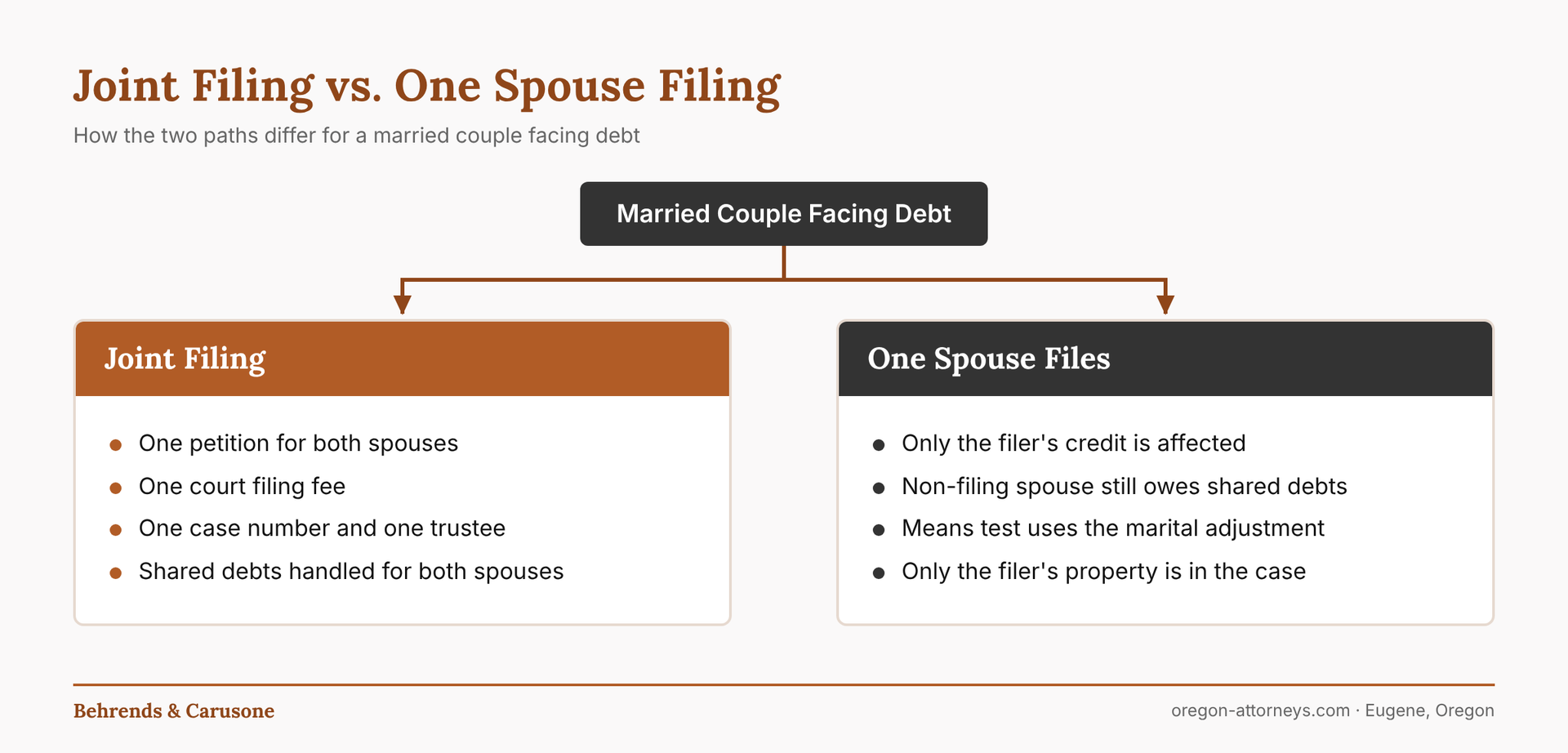
In a joint case:
- The court assigns one case number and one bankruptcy trustee.
- Both spouses attend a single meeting of creditors.
- Each spouse receives their own discharge of qualifying debts, and each spouse's eligibility is checked separately.
Who Can File Jointly?
Only spouses who are legally married on the day the petition is filed can file a joint case under the Bankruptcy Code. Unmarried couples who live together or share bills cannot file jointly; if both need relief, each must file a separate case.
Benefits of Filing Bankruptcy Together
For couples with shared debts, filing together has several practical advantages.
Lower Court and Legal Costs
A married couple filing jointly pays a single court filing fee, $338 for Chapter 7 or $313 for Chapter 13, instead of paying for two petitions. You also prepare one set of paperwork and attend one meeting of creditors, and attorney fees for one joint case are usually lower than fees for two separate cases.
Relief From Shared Debts for Both Spouses
If you both signed for a credit card, a personal loan, or a car loan, each of you is liable for the full balance. When only one spouse files, that spouse's liability is wiped out, but creditors can still pursue the non-filing spouse for everything that's left. A joint case eliminates or restructures the debt for both of you at the same time.
The Automatic Stay Protects You Both
Filing triggers the automatic stay, a federal court order that stops most collection calls, lawsuits, repossessions, and garnishments. In a joint case, it protects both spouses from the moment the case is filed. If garnishment is already squeezing your budget, our guide to Oregon garnishment laws explains how quickly filing stops payroll deductions.
Exemptions Can Go Further
Exemptions decide what property you keep. In a joint case, each spouse can usually claim many exemptions separately, which can protect more of what you own together. The homestead exemption is the main exception, as we explain below.
Joint Filing vs. One Spouse Filing
Here's how the two approaches compare side by side:
| Factor | Joint Filing | One Spouse Files |
|---|---|---|
| Court filing fee | One fee covers both spouses ($338 Ch. 7 / $313 Ch. 13) | One fee for the filing spouse; a second fee if the other spouse files later |
| Credit reports | Appears on both spouses' credit reports | Appears only on the filing spouse's report (joint accounts may still show it) |
| Shared debts | Discharged or restructured for both spouses | Filing spouse is released; the non-filing spouse still owes the debt unless the Chapter 13 co-debtor stay applies |
| Means test income | Both spouses' income counts in full | Household income counts, minus the marital adjustment |
| Property in the case | Both spouses' property, with exemptions for each spouse | Only the filing spouse's property and ownership interests |
When Filing Separately Makes More Sense
Joint filing is common, but filing separately is the better choice in some situations.
One Spouse Holds Most of the Debt
If most of the debt is in one spouse's name, such as debt from before the marriage or business debt only one of you signed for, keeping the other spouse out of the case protects that spouse's credit. A joint bankruptcy stays on both credit reports for up to 10 years after a Chapter 7 and up to 7 years after a Chapter 13. A spouse with clean credit can keep it for a future car loan or mortgage.
One Spouse Isn't Eligible for a Discharge Yet
Federal law limits how often you can receive a discharge. For example, you can't receive a Chapter 7 discharge if you received one in a case filed within the past eight years, and other waiting periods apply to Chapter 13. If one spouse is still inside a waiting period, the other spouse can file alone and deal with pressing debt now.
One Spouse Owns Separate Property or a Business
If one spouse owns a small business, inherited property, or real estate from before the marriage, a joint case brings all of it into the bankruptcy. When the debt belongs mostly to the other spouse, a separate filing keeps that property out of the case entirely.
Household Income and the Oregon Bankruptcy Means Test
Some couples assume one spouse can file alone to get under the Chapter 7 income limit. It usually doesn't work that way. The Oregon bankruptcy means test looks at household income whether one or both spouses file.
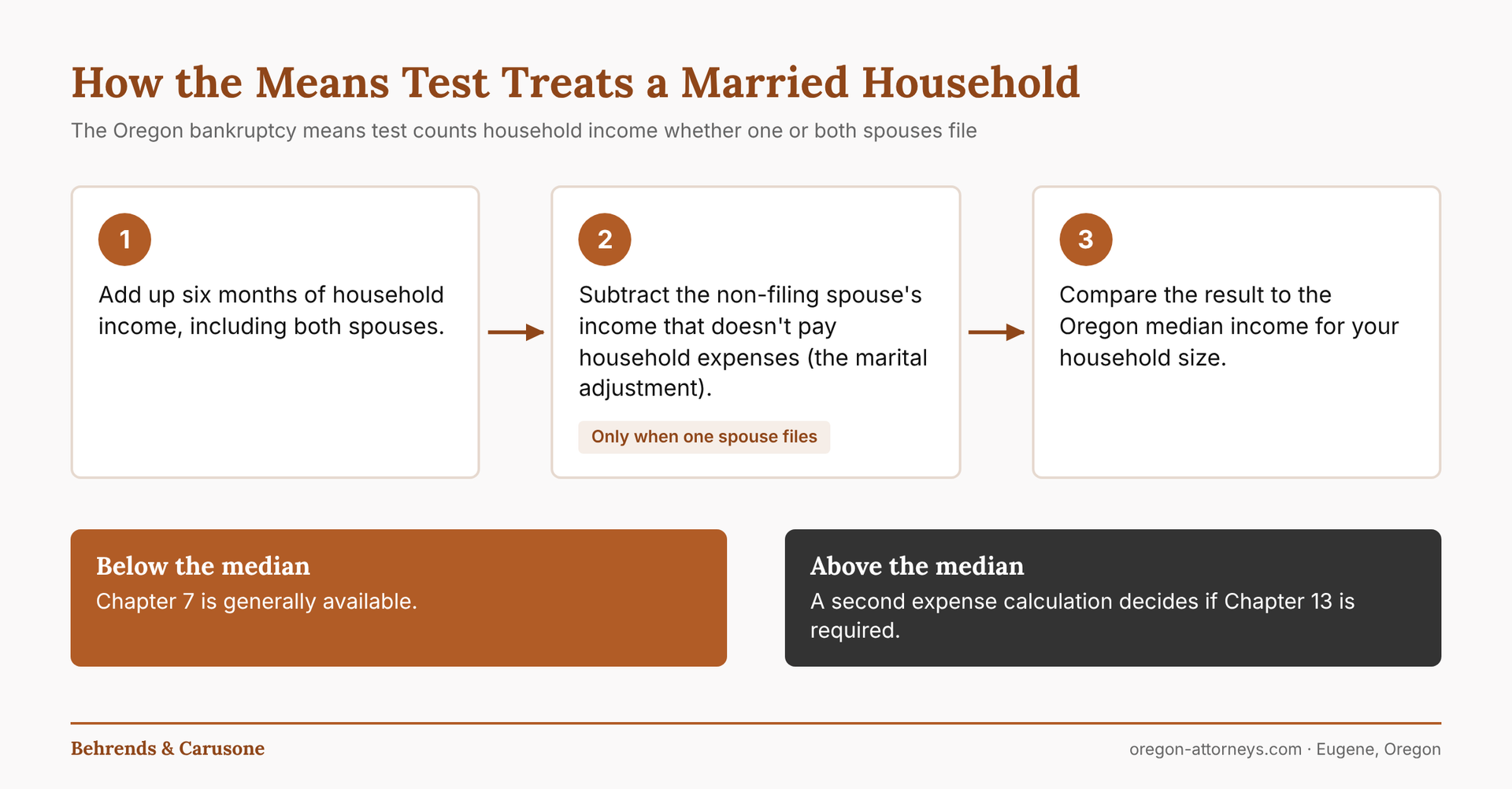
When only one spouse files, Official Form 122A-1 allows a marital adjustment. The filing spouse can subtract the part of the non-filing spouse's income that doesn't go toward household living costs, such as that spouse's own student loan payments, separate tax debts, or a car payment in their name alone. In a joint case, both incomes count in full.
You can check the current income limits for your household size in the U.S. Trustee Program's means testing data. If your income is above the Oregon median, our Chapter 7 vs. Chapter 13 comparison explains what that means for your options. We run the numbers both ways, joint and separate, before you decide.
Oregon Bankruptcy Exemptions for Married Couples
Exemptions decide what property you keep when you file. Oregon is one of the states that lets you choose between Oregon's exemptions and the federal bankruptcy exemptions. You can't mix and match between the two lists, and in a joint case both spouses must use the same system. For many couples, that choice is the biggest decision in the case.
The Oregon Homestead Exemption
Home equity is often a married couple's largest asset. Oregon raised its homestead exemption in 2024 under ORS 18.395 and now adjusts it for inflation every July 1. Starting July 1, 2026, it protects:
- One debtor: up to $158,300 in home equity.
- Two or more debtors in the same household: up to $316,700 combined.
The household figure is not two single exemptions added together; spouses share the higher combined amount. You can confirm the current figures on the Oregon Judicial Department's homestead exemption table. The larger amounts don't apply to debts for child support, spousal support, or criminal restitution.
The federal homestead exemption is much smaller: $31,575 per person, or $63,150 when a couple doubles it. For homeowners with real equity, choosing the Oregon bankruptcy exemptions is often what keeps the family home safe.
Oregon vs. Federal Exemptions at a Glance
Here's how the main exemptions compare for each spouse:
| Exemption | Oregon (per debtor) | Federal (per debtor) | Joint filing notes |
|---|---|---|---|
| Homestead (home equity) | $158,300 | $31,575 | Oregon: $316,700 combined for two household debtors. Federal: doubles to $63,150. |
| Motor vehicle | $10,000 | $5,025 | Each spouse can protect a vehicle under either system. |
| Tools of the trade | $5,000 | $3,175 | Each working spouse can claim this exemption. |
| Wildcard (any property) | $400 | $1,675, plus up to $15,800 of unused homestead | The federal wildcard doubles for joint filers, which often helps couples who rent. |
Sources: ORS 18.345 and ORS 18.395 (Oregon); 11 U.S.C. § 522(d), as adjusted April 1, 2025 (federal).
Many Oregon exemptions can be claimed by each spouse in a joint case, while a few, like the $3,000 household goods exemption, are shared by the household. The Oregon vehicle exemption drops to $3,000 for support and restitution debts. Federal exemptions double for joint filers, and the federal wildcard often helps couples who rent and have savings to protect. Our guides to federal bankruptcy exemptions and asset protection in bankruptcy cover specific property in more detail.
The 730-Day Residency Rule
You can use Oregon's exemptions only if Oregon has been your home for at least 730 days (two years) before you file. If you moved here more recently, federal law looks back to where you lived for the longest part of the 180 days before that two-year window, and that state's exemptions may apply instead.
How Your Home Is Titled Matters in Oregon
How your deed is titled can change which filing strategy makes sense.
Tenancy by the Entirety
Oregon recognizes tenancy by the entirety, a form of real estate ownership only for married couples. In some states it shields a home when only one spouse files. Oregon's protection is weaker, because courts here have allowed a creditor of one spouse to reach that spouse's interest in the property. A single-spouse filing that involves real estate needs a careful look at the title.
Oregon Is Not a Community Property State
Unlike Washington or California, Oregon is not a community property state. Debts one spouse takes on alone during the marriage don't automatically become the other spouse's legal obligation, although Oregon's family expense law can make both spouses responsible for some household costs. Keeping individual credit accounts separate can give one spouse the option of filing alone later.
Chapter 7 vs. Chapter 13 for Joint Filers
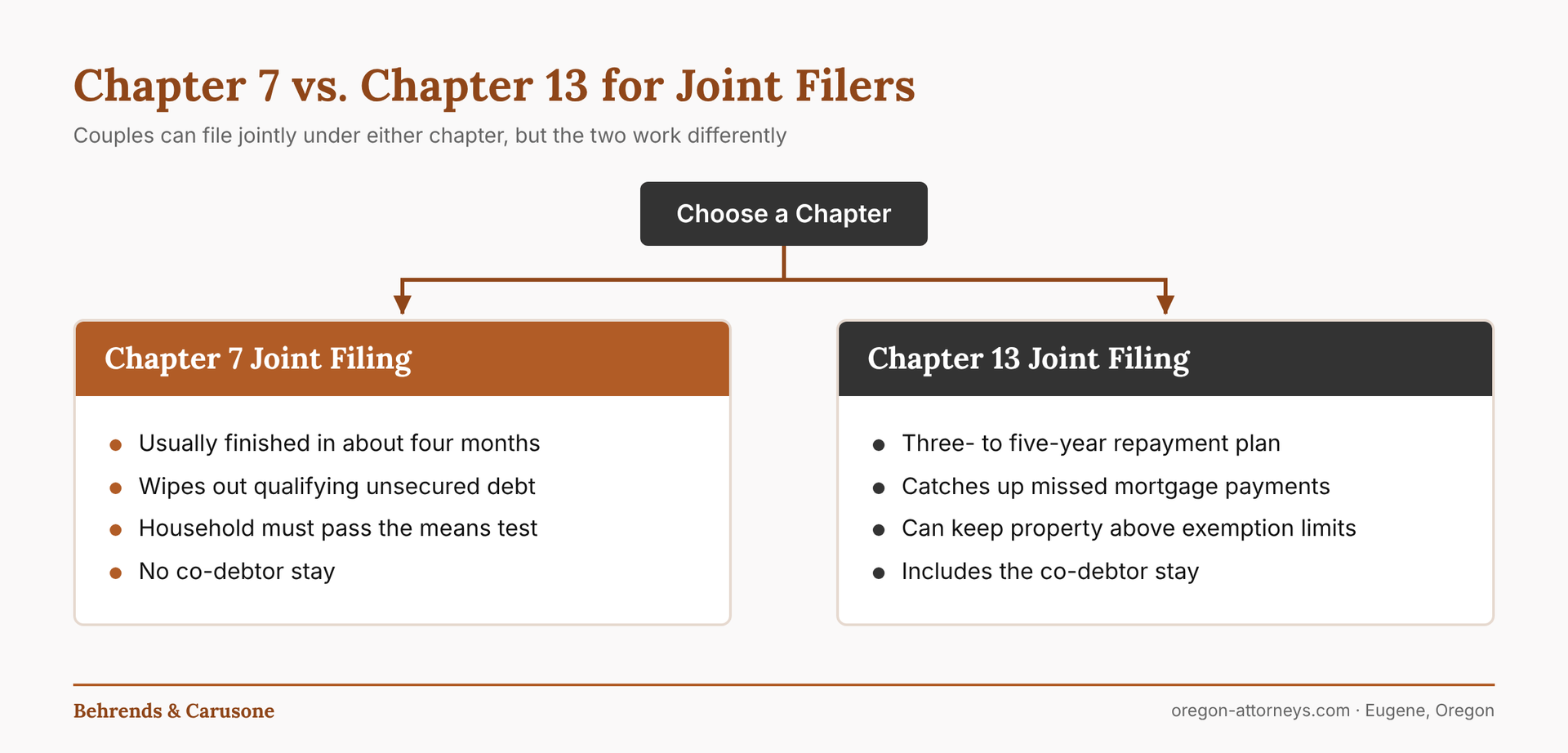
Couples can file jointly under either chapter, but the two work differently.
Chapter 7 Joint Filing in Oregon
A Chapter 7 joint filing in Oregon wipes out qualifying unsecured debt, such as medical bills, credit cards, and personal loans, usually within about four months. If your household passes the means test and your property fits within your exemptions, Chapter 7 gives both spouses a fast fresh start. A trustee can sell property that isn't protected by an exemption, which is why the exemption choice matters so much for couples who own a home or have savings.
Chapter 13 Joint Filing in Oregon
Chapter 13 combines your debts into a three- to five-year repayment plan supervised by a trustee and based on what your household can afford. Couples often choose Chapter 13 to:
- Stop a foreclosure and catch up on missed mortgage payments over time.
- Restructure car loans and lower monthly vehicle payments.
- Keep property worth more than the exemption limits.
Chapter 13 also has debt limits, and in a joint case they apply to both spouses' debts together.
The Co-Debtor Stay in Chapter 13
When one spouse files Chapter 13, the co-debtor stay (11 U.S.C. § 1301) generally stops creditors from collecting consumer debts from codebtors, including a non-filing spouse who co-signed the same loan or credit card, while the plan is active. That can let one spouse file alone while still shielding the other from collection. Chapter 7 has no co-debtor stay.
The Joint Filing Process in Eugene and Lane County
Couples in Lane County file with the U.S. Bankruptcy Court for the District of Oregon, which has divisions in Portland and Eugene. Here's how a joint case usually moves forward:
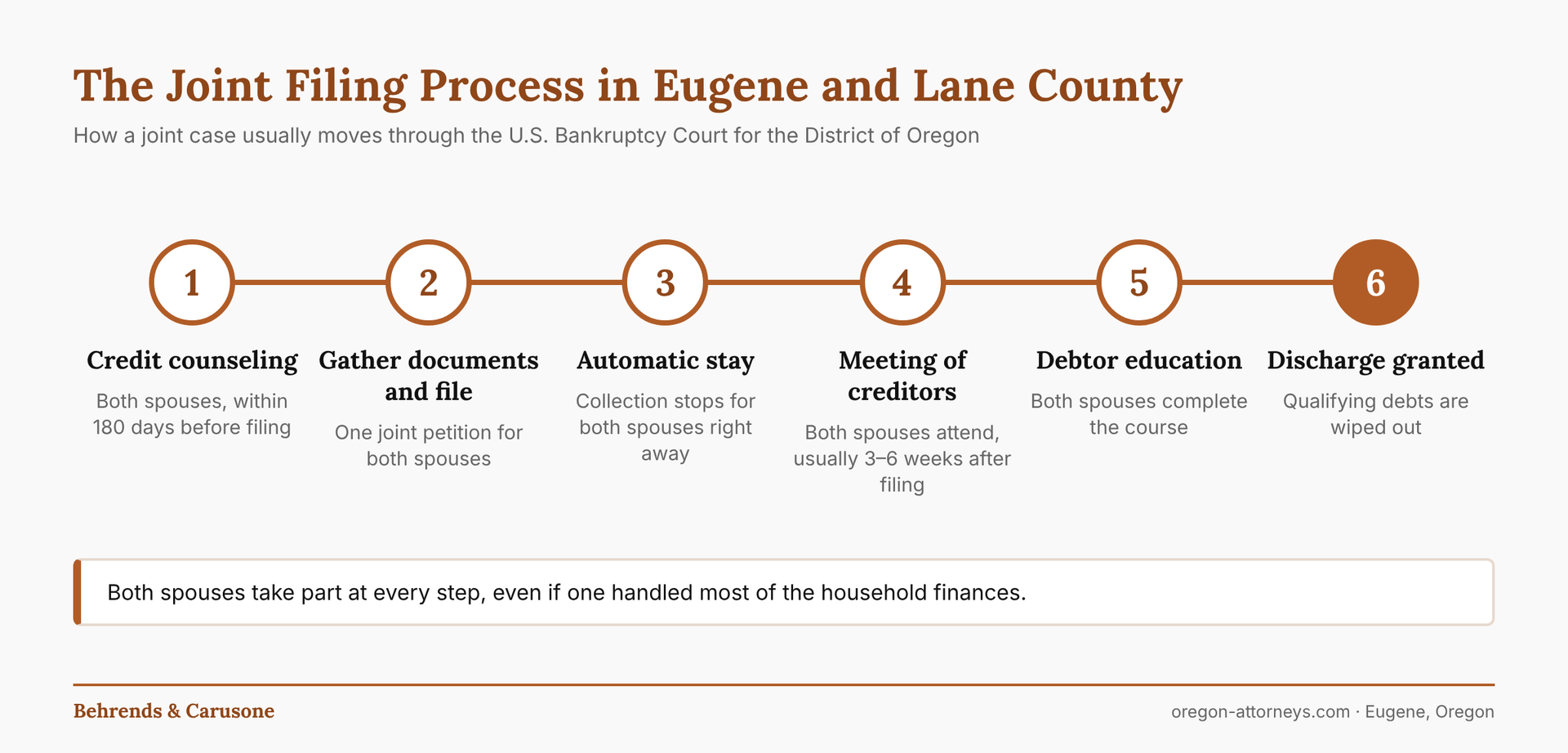
- Credit counseling: Both spouses complete counseling with a U.S. Trustee-approved agency within 180 days before filing.
- Documents: You gather tax returns, pay stubs, bank statements, property records, and debt notices for both spouses. Our checklist of documents you need to file bankruptcy helps you prepare.
- Filing: We file the joint petition, and the automatic stay takes effect right away.
- Meeting of creditors: Usually three to six weeks after filing, both spouses meet with the trustee to confirm the information in the petition.
- Debtor education and discharge: Both spouses complete a financial management course, and the court then issues the discharge order.
Talk With a Eugene Bankruptcy Attorney Before You Decide
Filing together or filing alone affects what you keep, what you pay, and how quickly you recover. We'll review both spouses' income, debts, and property under Oregon bankruptcy laws and show you how each option plays out. Contact Behrends & Carusone to schedule a confidential consultation with our Eugene office.
This article is for general information only and is not legal advice. Bankruptcy outcomes depend on your specific facts, so talk with a bankruptcy attorney about your situation.
Joint Bankruptcy in Oregon FAQ's
Can a joint bankruptcy be split into two separate cases later?
Yes. Under 11 U.S.C. § 302(b), the court can divide a joint case into two separate cases. This usually happens when spouses start a divorce or their interests begin to conflict. When the couple asks for the split, the court charges a fee equal to the original filing fee for that chapter.
Can we file jointly if we're separated or going through a divorce?
Yes, as long as you're still legally married on the day you file. If the separation is contested, one attorney usually can't represent both spouses because of conflicts over property and debts, and separate cases are often the cleaner approach.
How does filing alone affect my spouse's credit?
Your bankruptcy goes on your credit report, not your spouse's. Joint accounts listed in your case may still be reported as included in bankruptcy, which can lower your spouse's score for a while.










Share On: